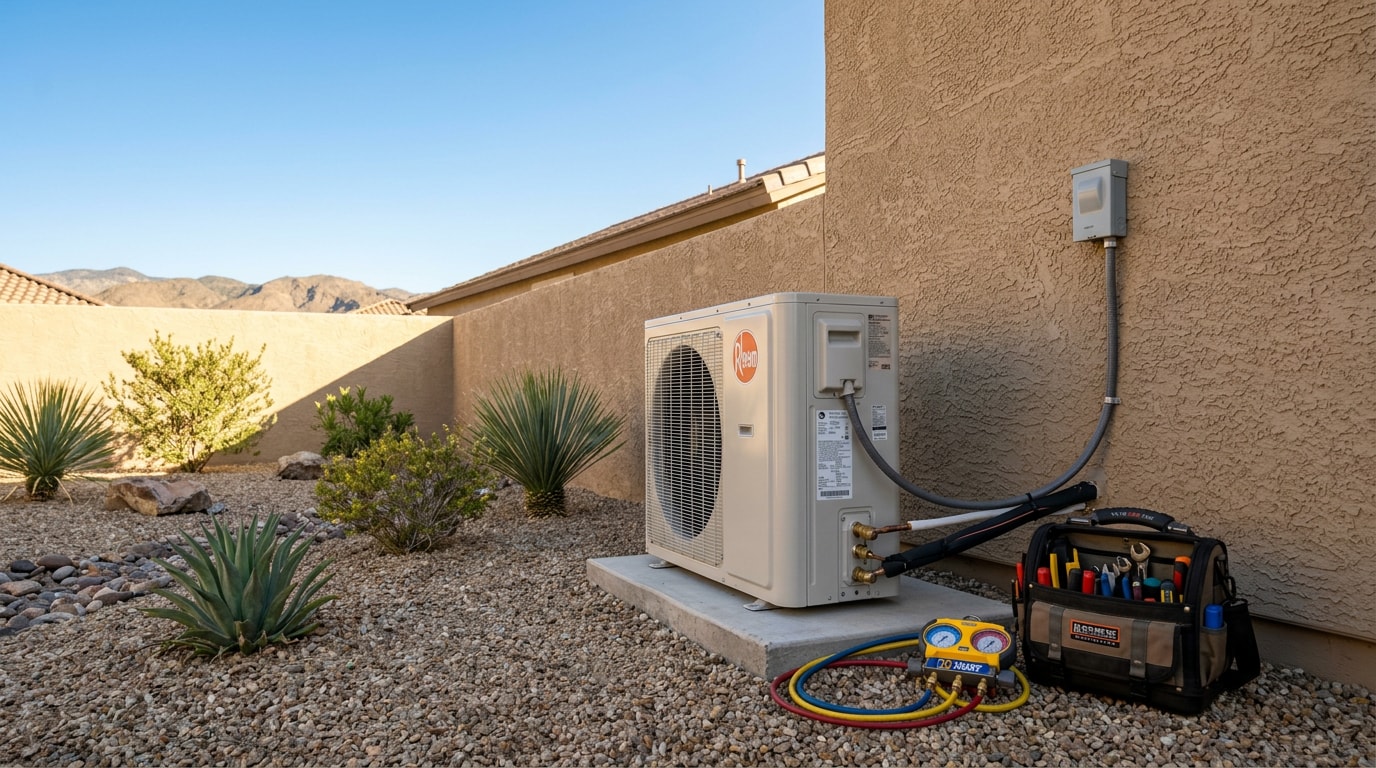
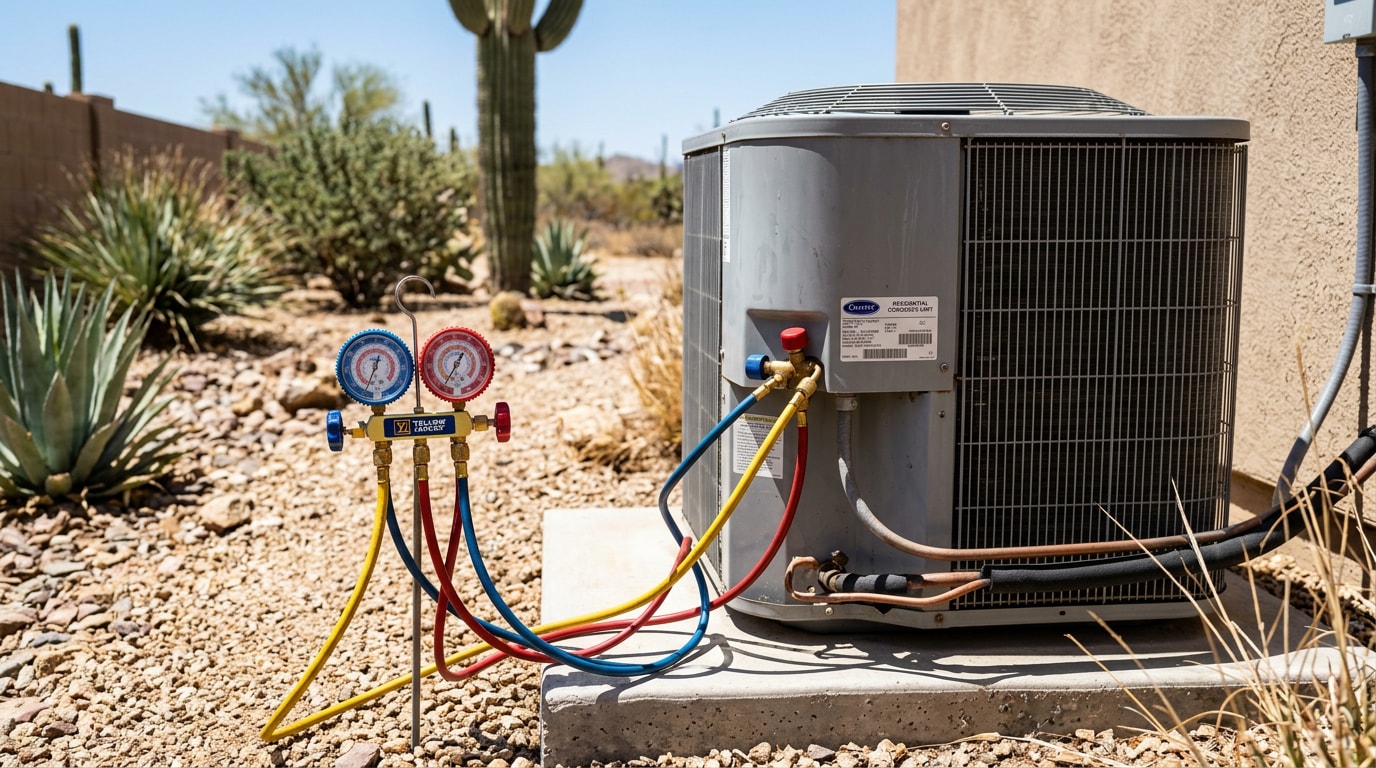
If you're trying to recharge AC in Mesa, AZ this week, your system is almost certainly low on refrigerant and losing the fight against triple-digit heat. A recharge can restore cooling fast, but it's only the right fix if a technician finds and addresses why the refrigerant dropped in the first place. Here's what the service costs in 2026, what causes the drop, and how to avoid paying for the same recharge twice.
Visit Cobre Valley Air LLC to see our services and request a free estimate.
What Does It Mean to "Recharge" an AC System?
A home AC recharge means a technician adds refrigerant back into a sealed system that has dropped below its factory-specified charge. Refrigerant doesn't get "used up" the way gasoline does. A properly sealed system holds the same charge for the life of the equipment, so if your AC needs refrigerant, something let it escape.
That's the part a lot of homeowners miss. A recharge without leak detection is a temporary patch, not a repair.
Signs Your Mesa Home Needs an AC Recharge
Low refrigerant shows up differently than most other AC problems. Watch for:
- Warm or weak airflow from vents even with the thermostat set low
- Ice forming on the indoor evaporator coil or outdoor refrigerant lines
- A hissing or bubbling sound near the indoor unit or copper lines
- Longer run times with the house never quite reaching the set temperature
- Higher-than-normal SRP or APS bills with no change in usage habits
In Mesa, these symptoms escalate fast once outdoor temps clear 105°F. A system that's "a little warm" in May is often blowing nothing but hot air by July, because the cooling demand on a low-refrigerant system keeps climbing while the charge keeps dropping. If your system has already stopped cooling entirely, don't wait on a routine appointment. Our emergency AC repair team handles same-day calls across the Valley for exactly this situation.
Why AC Systems Lose Refrigerant in Mesa's Climate
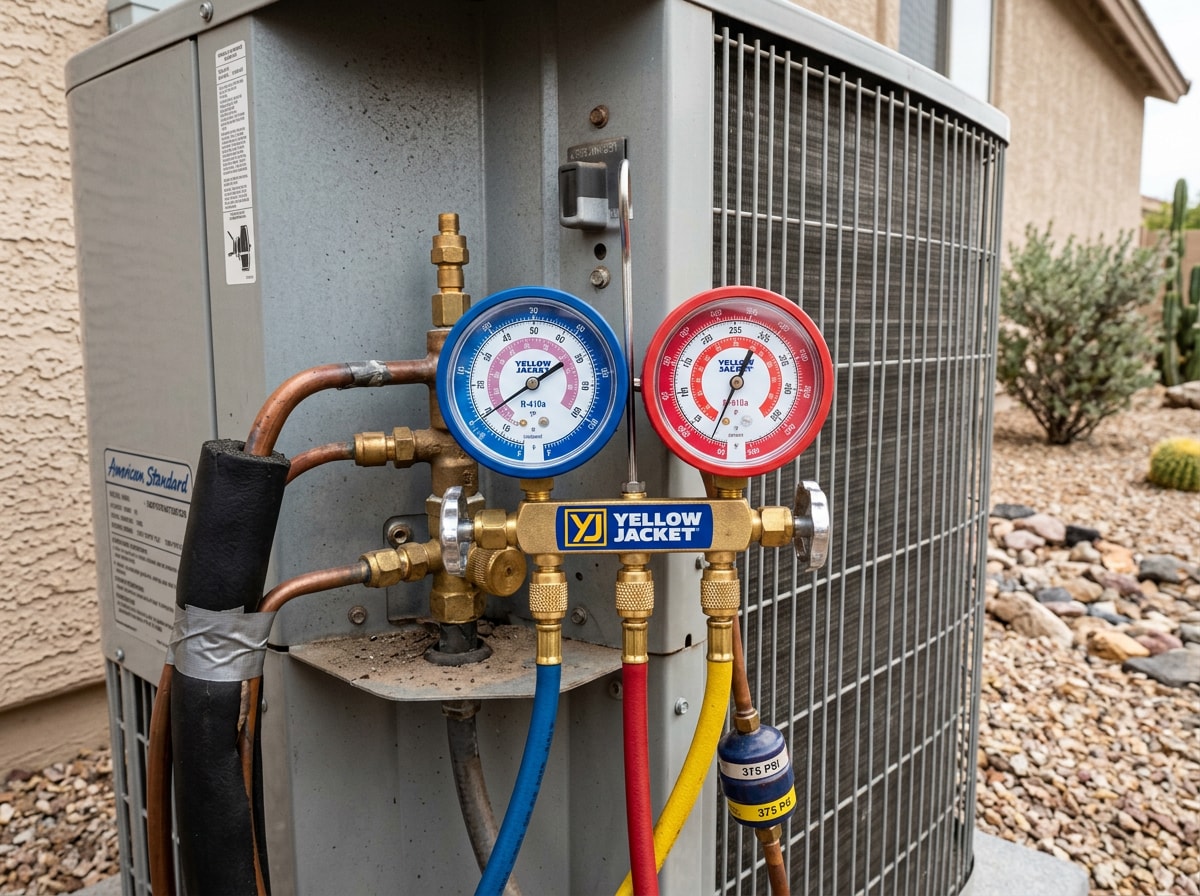
Refrigerant loss almost always traces back to a leak, and Mesa's heat accelerates the wear that causes them. The most common culprits we find on service calls are:
- Corroded evaporator coils from years of monsoon humidity cycling with dry heat
- Vibration-loosened fittings at the condenser, especially on units over 8–10 years old
- Rubbed or punctured line sets where copper tubing contacts ductwork, insulation, or framing
- Factory defects in coils, which some manufacturers have issued extended warranties for
A system that's been topped off more than once without a leak search is usually leaking from one of these points. Chasing the symptom instead of the leak is how a $300 recharge turns into three $300 recharges over two summers.
How Much Does an AC Recharge Cost in Mesa, AZ in 2026?
Pricing depends almost entirely on refrigerant type. Older systems use refrigerants that cost far more per pound than what's installed in new equipment today.
| Refrigerant Type | Typical Mesa Recharge Cost (2026) | Common In |
|---|---|---|
| R-410A | $200–$600 | Most systems installed 2010–2024 |
| R-454B | $250–$750 | New systems installed 2025 and later |
| R-22 (legacy/Freon) | $400–$1,200+ | Systems installed before ~2010 |
| Full evacuation + recharge | $450–$900 | Major leak repair or coil replacement |
These are general ranges, not a quote. Exact pricing depends on how many pounds your system needs, line-set length, and whether a leak repair is required before refrigerant goes back in. A comprehensive assessment before any refrigerant work gives you a firm number instead of a guess.
Why R-22 Recharges Cost So Much More Now
If your system is old enough to use R-22, expect sticker shock. The EPA banned production and import of virgin HCFC-22 in the United States starting January 1, 2020, with only recycled and reclaimed supply remaining legal for service afterward. That shrinking supply is why R-22 now costs several times more per pound than modern alternatives, and why a recharge on an R-22 system can approach what a repair on a newer unit would cost.
The same pressure is starting to build on R-410A. Under the EPA's AIM Act, new residential AC equipment manufactured from January 1, 2025 forward must use a refrigerant with a global warming potential below 700, which is why manufacturers have shifted new production to lower-GWP options like R-454B. R-410A remains legal to use for servicing existing systems, but expect it to follow R-22's pricing pattern as supply tightens over the next several years.
Recharge, Repair, or Replace? How to Decide
A recharge makes sense when the system is otherwise healthy and the leak is small, cheap to access, and confirmed by testing. It stops making sense when:
- The unit is 12+ years old and still runs on R-22
- A leak has already been "fixed" and recharged more than once
- The compressor shows signs of strain (hard starts, breaker trips, loud startup)
- A quoted recharge-plus-repair cost gets close to half the price of a new system
When refrigerant problems keep recurring, it's often cheaper long-term to stop repairing and start comparing AC replacement options instead of funding another season of top-offs.
What Happens During a Professional AC Recharge
A proper recharge is a diagnostic process first and a refill second.
- Airflow and pressure check — confirms refrigerant is actually the issue, not a blower or duct restriction
- Leak search — typically UV dye or an electronic leak detector, since refrigerant naturally fluoresces at the leak point
- Leak repair (if found) — sealing or replacing the failed fitting, coil, or line before adding any refrigerant
- Evacuation — pulling a vacuum on the system to remove air and moisture
- Recharge by weight — refrigerant added to the exact factory specification, not "topped off by feel"
Anyone adding or removing refrigerant from a residential system is legally required to hold EPA Section 608 certification, which is the federal credential for refrigerant handling under the Clean Air Act. Ask to see it before work starts. For a full breakdown of what a diagnostic visit covers before any refrigerant is touched, our AC diagnostic guide for Mesa homeowners walks through the exact checklist.
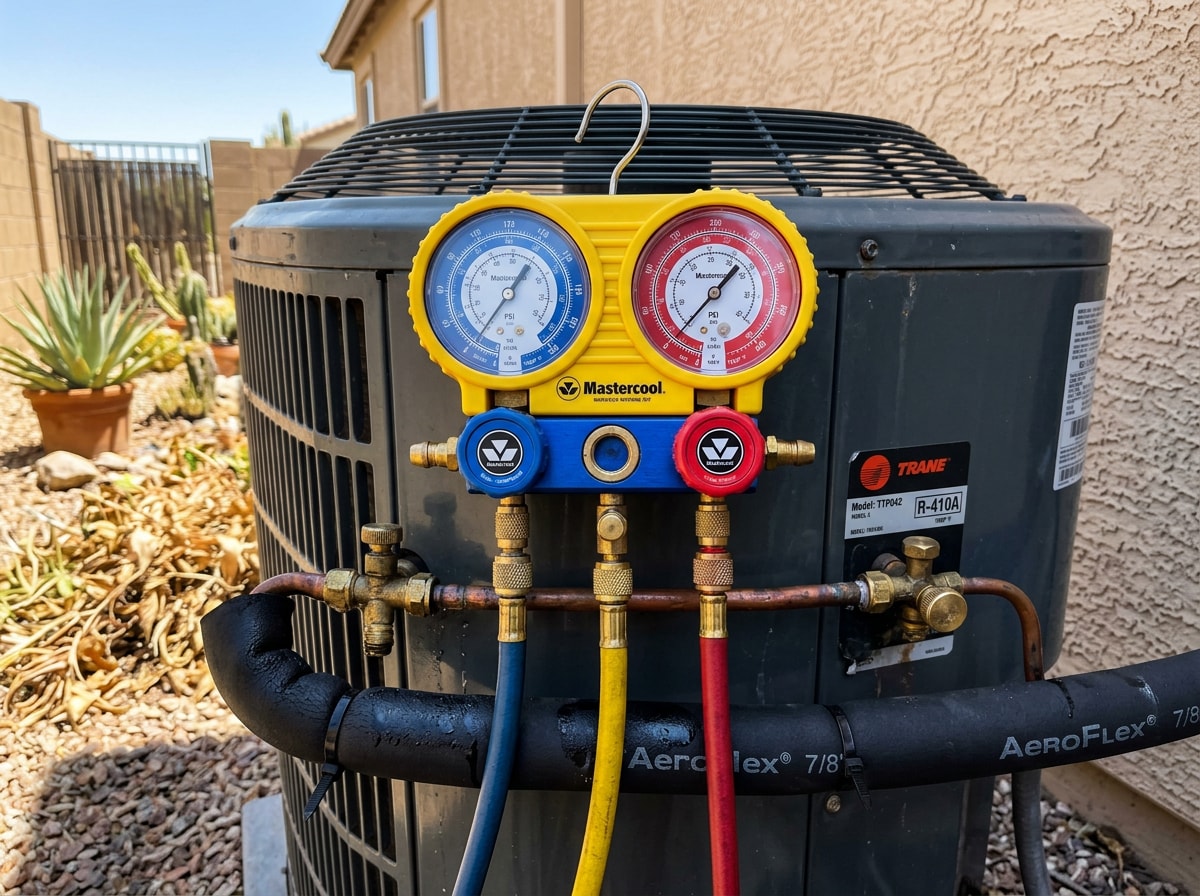
Why Refrigerant Alone Rarely Fixes the Real Problem
Skipping leak detection is the single most common mistake we see homeowners pay for twice. A recharge without finding the leak buys a few weeks or months of cooling before the symptoms return, usually worse, because a system running low on charge forces the compressor to work harder and run hotter than it was designed to. Repeated low-charge cycles are one of the fastest ways to shorten compressor life, which turns a $300 recharge problem into an $1,800+ compressor problem. If a shop offers to "just add some Freon" without checking for a leak first, that's a signal to get a second opinion.
Choosing a Licensed AC Contractor in Mesa
Arizona requires HVAC contractors to carry an active license through the Arizona Registrar of Contractors, and technicians handling refrigerant must separately hold EPA Section 608 certification. Cobre Valley Air is licensed under AZ ROC #339078 and has completed more than 1,000 installs across the East Valley, including Mesa, Gilbert, Apache Junction, and Queen Creek. Before you book anyone for refrigerant work, ask for both credentials, a written diagnostic report, and a leak-detection step, not just a price per pound.
Our team also covers the Mesa, AZ service area directly, along with routine AC maintenance service that catches small leaks before they turn into a mid-summer no-cool call. You can see examples of completed system work on our recent projects page.
Ready to find out whether your system needs a simple recharge or something bigger? Schedule a free inspection and we'll give you a straight answer before any refrigerant changes hands.
FAQ
How much does it cost to recharge a home AC in Mesa, AZ?
Most recharges run $200–$750 depending on refrigerant type, with R-410A and R-454B systems at the lower end and older R-22 systems running $400–$1,200 or more. Full evacuation and recharge after a leak repair typically lands at $450–$900.
How long does an AC recharge last?
If the underlying leak was found and repaired, a recharge should last for the life of the system. If it wasn't, expect symptoms to return within a few weeks to a few months, since the refrigerant is still escaping from the same point.
Can I recharge my own home AC unit?
No. Adding or removing refrigerant from a residential AC system legally requires EPA Section 608 certification. DIY recharge kits sold for cars don't match residential refrigerant specifications, and overcharging a home system can damage the compressor.
How do I know if I need a recharge or a new AC unit?
A recharge makes sense for a younger system with one small, repairable leak. Replacement starts making more financial sense once the unit is 12+ years old, uses R-22, or has already been recharged more than once for the same leak.
What refrigerant does my AC use?
Check the nameplate on the outdoor condenser. Systems installed roughly 2010–2024 typically use R-410A, systems from 2025 forward use R-454B, and anything installed before about 2010 likely uses R-22.
Is low refrigerant covered under my AC's warranty?
Refrigerant itself usually isn't covered, but if the leak traces back to a defective coil, many manufacturers cover the part under a parts warranty. Labor to diagnose and repair it is typically a separate cost unless you have an extended labor warranty.